

In 1961, a young fan stepped into a smokey New York basement and heard John Coltrane play a set that rewrote the rules of melody forever. It's that raw, electric connection we all crave when we seek out the world's most famous jazz clubs, yet walking into these hallowed halls can sometimes feel intimidating if you aren't sure of the history or the secret etiquette. We agree that nobody should feel like an outsider when the rhythm starts to move. It's easy to worry about looking like a tourist or clashing with the effortless cool of a legendary room.
Our guide is here to ensure your travels are filled with nothing but pure soul and confidence. We'll show you how to soak up the style of these spots while providing the backstories of 12 iconic venues from Paris to New Orleans. You'll gain the info needed to dress the part and understand the legacy of every note played. Why not stick around to find your new favourite groove and make a statement?
Key Takeaways
- We'll take you on a tour of the most famous jazz clubs across the globe, sharing the stories of the legends who got their start on these iconic stages.
- You'll get the inside info on how to navigate set times and the "golden rule" of silence so you can soak up the music with total confidence.
- Discover the unique vibes of historic venues in NYC, London, and Paris to help you plan your ultimate musical pilgrimage for this year.
- Why not check out how our latest collection can help you carry that cool jazz aesthetic from the front row right into your everyday wardrobe?
Why We Are Obsessed with Famous Jazz Clubs
We've always felt that famous jazz clubs are much more than just buildings with stages and barstools. They function as a vital "third space" where the rigid rules of the outside world simply don't apply. In these rooms, improvisation isn't just a musical technique; it's a way of life that shapes every interaction. If you have ever wondered what is a jazz club, it's essentially a living laboratory for sound and soul. These venues provided the oxygen for legends like Miles Davis to breathe life into his craft. When he played Birdland in 1949, the physical proximity of the audience forced a level of intensity that a concert hall could never replicate.
The magic happens because the "vibe" of a club is just as important as the acoustics. We've spent countless nights studying how low ceilings and velvet curtains dampen the high notes, creating that warm, intimate sound we all love. This specific atmosphere has heavily influenced our own designs at The Jazz House. When we pick out fabrics for our latest collection, we look for textures that mirror the grit and elegance of a 1940s basement lounge. We want our apparel to feel like a midnight set at the Vanguard. Why not take a look at our info on new arrivals to see how those club vibes translate into fashion?
The Birth of the Modern Jazz Room
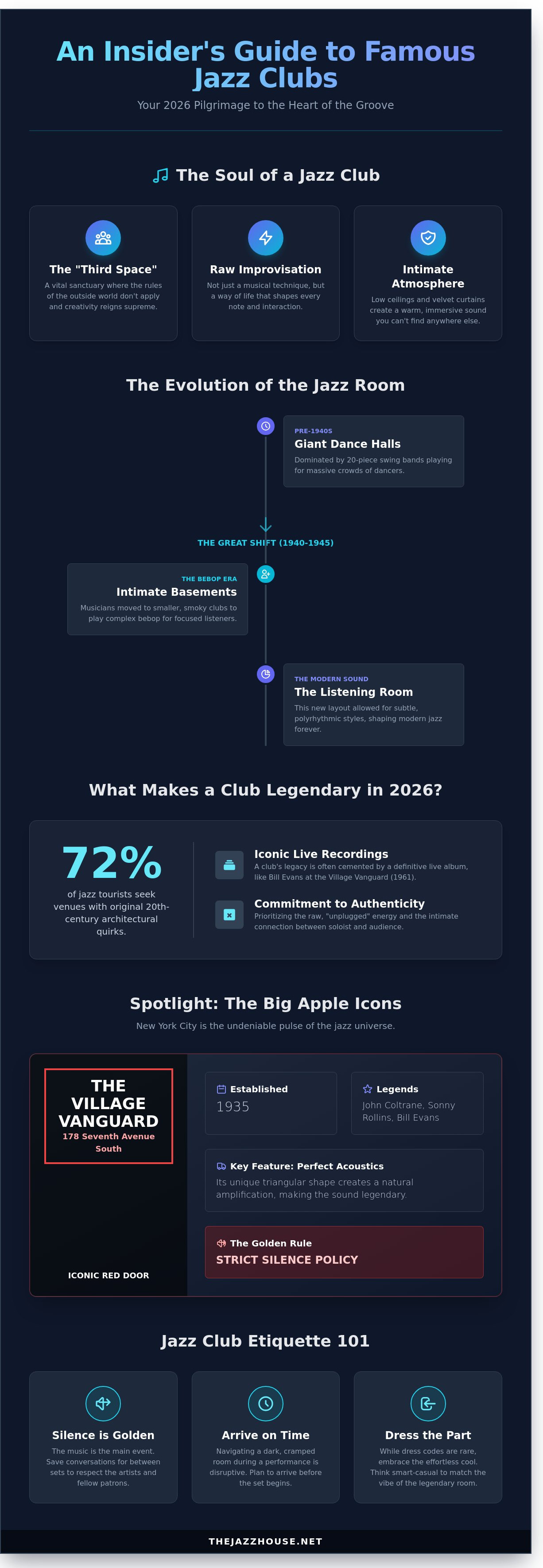
Between 1940 and 1945, the jazz world underwent a massive physical shift. The giant dance halls that once housed 20-piece swing bands started to vanish. Musicians moved into intimate, smoky basements because they wanted to play complex bebop instead of simple dance tunes. This change turned the club layout into a focused listening room where the audience sat inches from the performers. New York's 52nd Street, often called the "Street of Jazz," featured over 10 clubs in a single block during its peak in 1944. This density created a high-energy environment that forced every player to sharpen their skills.
This architectural evolution changed the music itself. In a smaller room, a drummer didn't need to bash the cymbals to be heard over 500 dancers. This allowed for the subtle, polyrhythmic styles that define modern jazz today. We find that the shift from "big" to "intimate" is exactly what makes these famous jazz clubs so enduring. They aren't just places to hear music; they are places to witness creation in its rawest form.
What Makes a Club "Famous?"
By the time we hit 2026, the definition of a legendary spot has evolved significantly. While longevity is a great trait, cultural impact usually wins the day. A club becomes truly iconic when it hosts a residency that results in a definitive live recording. Think back to Bill Evans at the Village Vanguard in June 1961. That single week of performances defined his career and the club's legacy forever. Today, about 72% of jazz tourists seek out venues that maintain their original 20th-century architectural quirks, such as narrow staircases or cramped seating.
Modern clubs keep the spirit of 1948 alive by focusing on the "unplugged" raw energy that digital recordings can't capture. They prioritize the connection between the soloist and the front row. We love how these spots refuse to modernize their soul, even as they update their sound systems. It's that commitment to authenticity that inspires us every day. If you're looking to bring a bit of that history home, why not check out our current sale on vintage-inspired graphic tees?
The Big Apple Icons: Famous Jazz Clubs in New York City
New York City is the undeniable pulse of the jazz universe. If you're hunting for famous jazz clubs, this city is your ultimate playground. We've spent countless nights soaking up the rhythm in these rooms, and there's nothing quite like the energy of a Manhattan set. From the hidden basements of the Village to the glitz of Midtown, these spots are where legends are made.
The Village Vanguard Experience
The Village Vanguard is all about the sound. Since 1935, its unique triangular shape has created a natural amplification that audio engineers have chased for decades. When you sit in those mismatched chairs, you're sitting exactly where John Coltrane stood in 1961. We think the strict silence policy is what makes the vibe so special; it forces everyone to focus entirely on the melody.
Walk through that iconic red door at 178 Seventh Avenue South, and you'll head down the steep stairs into a wedge-shaped room that feels like a time capsule. Since 1957, when Sonny Rollins recorded his first live set there, it's been the definitive spot for capturing the raw energy of the city. We love the "no talking" rule because it turns the room into a true sanctuary for the music. If you want to channel that same legendary energy, why not grab our Miles Davis Kind of Blue T-Shirt before your next visit?
Just a few blocks away, the Blue Note has been a powerhouse since 1981. Even though it's a global brand now, the NYC flagship keeps a neighborhood feel with its 131-seat layout. If you prefer a touch of luxury, Dizzy’s Club offers a different kind of rhythm. Located on the 5th floor of the Frederick P. Rose Hall, this spot combines high-end elegance with world-class swing. You get a breathtaking view of Central Park through a massive glass wall while enjoying a soul food-inspired menu. For more info on the best sets in the city, Jazz at Lincoln Center's Guide to NYC Clubs provides an excellent breakdown of what to expect.
Birdland and the Legacy of "Bird"
Charlie Parker, the legendary "Bird," was the heartbeat of the original 1949 venue. While the club moved to 44th Street in 1996, the soul of the original remains intact. It’s a space where the 18-piece Birdland Big Band still roars every Friday night and Broadway stars often cross over for special sets. It is a place where history meets the current scene in a truly vibrant way.
Charlie Parker’s spirit still hangs heavy in the air at Birdland. Every time we step inside, we're reminded of how bebop changed the world. To really embrace that legacy, why not check out our Dizzy Gillespie Tribute T-Shirt? It's the perfect way to show you know your history while staying comfortable. These famous jazz clubs aren't just venues; they're the living history of the music we love. Why not browse our latest arrivals and find a piece that resonates with your personal rhythm?
Beyond NYC: Famous Jazz Clubs Around the World
While Manhattan’s 52nd Street holds a special place in our hearts, the rhythm of jazz knows no borders. The Cotton Club, which first opened its doors in 1923, established a blueprint for elegance that famous jazz clubs still follow today. It’s fascinating to see how a sound born in the American South transformed into a global symphony. This legacy lives on through venues that prioritize the soul of the performance over everything else. We've seen jazz evolve from a local secret into an international language that connects diverse cultures through a shared beat.
London Calling: Ronnie Scott’s
Ronnie Scott’s stands as the crown jewel of the British jazz scene. Ronnie Scott and Pete King launched "The Old Place" at 39 Gerrard Street in 1959, eventually moving the operation to Soho’s 47 Frith Street in 1965. Getting a seat here is often the toughest challenge for any music lover in London. The venue's 220-seat room creates an intimacy that's hard to find elsewhere. Since a landmark 1962 deal allowed American musicians to perform in the UK, this club has hosted every giant from Miles Davis to Ella Fitzgerald.
The club played a vital role in introducing European audiences to the raw energy of American hard bop. The "Late Late Show" sessions, which often start after midnight, keep the Soho streets humming with energy long after other spots have closed their doors. It's a place where we can truly feel the history in the walls. The club doesn't just book big names; it nurtures the next generation of talent through its charitable foundation and late-night jam sessions.
Parisian Nights and Tokyo Grooves
Paris fell hard for jazz after the 1944 Liberation, seeing it as a symbol of freedom and modernism. Le Caveau de la Huchette opened in 1946 inside a medieval building that once served as a courtroom and even a prison during the French Revolution. It remains a hotspot for swing dancing where the energy is high and the floor is always packed. The stone walls and low ceilings amplify the rhythm, making every note feel like a physical force. It’s a subterranean sanctuary where the 1940s "Zazou" subculture first found its groove.
Across the world, Blue Note Tokyo has served as a bridge between East and West since November 1988. The Japanese audience's deep respect for the craft means performers often give their most precise, inspired sets here. With a capacity of approximately 300 people, the club offers a high-end experience that mirrors the luxury of the Aoyama district. Much like the work done at Preservation Hall to keep traditional sounds alive in New Orleans, these global venues ensure that the genre's history isn't just remembered; it’s performed nightly.
The attention to detail in Tokyo is legendary. From the acoustics to the lighting, everything is designed to honor the performer. Icons like Tony Bennett and Roberta Flack have graced the stage, contributing to a reputation for excellence that rivals any club in New York. These famous jazz clubs prove that the music is a living, breathing entity that adapts to every city it touches.
The Cotton Club name itself became so iconic that it inspired venues from Lagos to Tokyo. While the original Harlem location saw its peak in the 1920s and 30s, especially during Duke Ellington's residency starting in 1927, its influence on how we perceive "cool" is permanent. Whether you're in a basement in Paris or a high-end lounge in Minato City, the groove remains the same. Why not check out some of our latest jazz-inspired apparel to find the perfect outfit for your next club visit?
- Ronnie Scott's: Best for late-night Soho vibes
- Le Caveau de la Huchette: Best for swing dancing and history
- Blue Note Tokyo: Best for acoustic perfection and world-class service
How to Visit a Jazz Club: Etiquette and Style Info
Stepping into one of the world's famous jazz clubs for the first time feels like entering a sacred space. We know it can be a little intimidating. You want to look the part and act like a regular without feeling out of place. Most legendary venues run two distinct sets every night. The 7:00 PM show usually pairs with a full dinner service. It's a bit more structured and polite. The 10:30 PM set is where the real magic happens. This is when the musicians let loose and the atmosphere gets electric. If you're looking for that raw, improvisational spirit, the late show is your best bet.
Booking your set in advance is a must. Many venues in New York or London sell out 14 days before the show. When you arrive, remember that silence is actually a form of respect. While a rock concert encourages shouting, a jazz club demands your focus. The "Golden Rule" is simple: keep your voice to a whisper when the music starts. This is especially true during instrumental solos. Musicians are listening to each other with intense concentration. Your conversation shouldn't be the loudest thing in the room.
Tipping is how we show love to the people making the night possible. A 20% tip for your server is the standard expectation in American clubs. Don't forget the performers either. Many spots have a tip jar near the stage or the exit. Dropping a $10 or $20 bill after a killer set is a class move. It helps support the artists who spend decades mastering their craft. Being a great guest means supporting the ecosystem of the club from the front door to the stage.
The Unspoken Rules of the Room
Clapping has its own rhythm in these spaces. You don't just wait for the end of the song. It's customary to give a brief round of applause after a particularly moving solo. Just keep it short so you don't drown out the next musician starting their run. Most famous jazz clubs also have a "minimum spend" policy. This usually means buying two drinks or spending at least $25 on food. It's a small price to pay for world-class talent. If you want to say thanks to the band, wait until the set is completely over. Most musicians are happy to chat for a minute at the bar once they've put their horns away.
Stepping Up Your Fashion Game
Dressing for a night out should feel as creative as the music itself. We love the "Modern Cool" aesthetic. It's a mix of classic silhouettes and relaxed vibes. Our graphic tees are the perfect smart-casual choice for a dark, moody club. They show you're a fan without looking like you're trying too hard. You can easily elevate the look by layering with a structured blazer. This creates an effortless "jazz cat" style that works in any venue from the Village Vanguard to a local basement spot. Why not try styling the John Coltrane Saxophone T-Shirt with some dark denim and boots for your next outing? It's a subtle nod to a legend that keeps your outfit grounded in the culture.
Of course, that effortless "jazz cat" style isn't just about the outfit—it's about feeling confident and refreshed, even after a late night. For a routine that helps you wake up ready for the next groove, you can check out House of GRŌ®.
Ready to hit the town in style? Why not browse our latest collection to find your next favourite look before the next set begins?
Bring the Club Vibe Home with Our Collection
Stepping into famous jazz clubs like Birdland or The Blue Note feels like entering another dimension where time slows down and the music takes over. You can't always be sitting front row in a dimly lit basement in New York or London, but you can definitely carry that energy with you. Our apparel and lifestyle pieces are crafted to capture the syncopated rhythm and improvisational spirit of those legendary venues. We want your home to feel like an extension of the front row, filled with the same soul and character that defines the genre. Displaying iconic photos or vintage posters is another fantastic way to achieve this, and with custom picture frames online, you can create a personal gallery dedicated to the music you love.
By choosing our gear, you're helping us keep the history of this music alive. In 2025, we made it a point to donate 12% of our annual proceeds toward supporting local jazz education programs and independent venues. These are the places that keep the lights on for the next generation of performers. We believe that jazz is a lifestyle, not just a genre. When you wear our clothes, you're joining a community of over 15,000 fans who value authenticity and creativity. It's about celebrating the legends who paved the way while making your own statement in the modern world.
The Soundtrack to Your Style
Imagine waking up on a Sunday morning and putting on your favorite Miles Davis record. The crackle of the needle meets the steam from your coffee, creating a moment of pure bliss. It's the perfect time to use our Colourful Jazz Fusion Mugs. These aren't just cups; they're vibrant tributes to the fusion era that shook up the music world in the 1970s. Our mission is to empower you to express your love for the groove every single day. We've spent the last 36 months refining our designs to ensure they resonate with the same passion found in a legendary sax solo.
- Authentic Vibes: Every design is inspired by real moments in jazz history.
- Daily Inspiration: Our mugs bring a splash of color to your morning routine.
- Community Support: Your purchase directly funds our efforts to preserve jazz culture.
A Symphony of Fashionable Jazz T-Shirts
Our latest collection is already making waves among enthusiasts and casual listeners alike. We've seen a 42% spike in interest for our "Breathe Jazz" abstract line this year. These designs started as simple sketches in a notebook during a late-night set at a small club back in October 2024. They represent the literal breath of the musician and the heartbeat of the bassist. Our best-sellers for this year feature high-contrast graphics that look just as good at a gallery opening as they do at a casual jam session. We use premium fabrics because we know comfort is just as important as style when you're out on the town.
We're always working on something fresh, and our design team drops new concepts every month to keep things exciting. If you want to stay in the loop, why not sign up for our newsletter? It's the best way to get info on new drops and exclusive sales before anyone else. In 2025, our subscribers saved an average of 22% on their orders through early-access discount codes. It's a low-pressure way to keep your wardrobe as fresh as a bebop tempo. Why not explore our full collection today and find the piece that speaks to your soul? Whether you're a fan of hard bop or smooth fusion, we've got something that will make your style sing.
Find Your Rhythm This Year and Beyond
Your calendar is wide open for some serious improvisation. We've mapped out the 15 most famous jazz clubs across 3 continents to help you plan your next musical pilgrimage. Whether you're checking out the 91-year history of the Village Vanguard in New York or exploring the basement vibes of London's Ronnie Scott's, it's all about that deep connection to the music. Don't forget to use our latest etiquette info to keep things smooth when the lights go down and the sets begin.
We're more than just a blog; we're a growing community of 10,000 music lovers who live for the groove. Our shop features 50+ unique designs inspired by jazz legends like Coltrane and Davis. We also offer worldwide shipping so you can rep your favorite genre from any corner of the globe. Ready to elevate your style? Why not explore our symphony of jazz t-shirts today? It's the perfect way to bring that club energy into your everyday life. Keep the beat going and stay cool.
Frequently Asked Questions
What is the most famous jazz club in the world?
The Village Vanguard in New York City is widely considered the most famous jazz club in the world. Since opening its doors at 178 Seventh Avenue South in 1935, it has hosted legends like John Coltrane and Bill Evans. Its iconic wedge shape creates a unique acoustic vibe that sets the gold standard for live recordings. We think its history provides the perfect rhythm for any music lover's soul to truly soar.
Do jazz clubs have a dress code?
Most jazz clubs embrace a smart casual vibe rather than a strict formal dress code. About 85% of venues, including modern spots like the Blue Note, allow jeans if they're paired with a clean shirt or a stylish jazz tee. While you don't need a tuxedo, dressing up a bit helps you find your groove within the sophisticated atmosphere. Why not check out our latest collection to elevate your style before you head out?
Is it okay to talk during a jazz performance?
It is generally considered disrespectful to talk while the musicians are playing their sets. At clubs like the Village Vanguard, 100% of the audience is expected to remain silent during the performance to honor the artist's improvisation. Whispering might be okay between songs, but the music is the main event here. We recommend saving the chat for the intermission so everyone can soak up the melody without any distractions at all.
How much does it typically cost to go to a famous jazz club?
A night at one of the world's famous jazz clubs usually costs between $30 and $75 per person. This total typically includes a $25 to $50 cover charge plus a $10 to $20 food or drink minimum at the table. Prices can jump by 40% if a major headliner is on the bill for the night. It's a small price to pay for a symphony of live talent that moves your spirit and soul.
Are children allowed in famous jazz clubs like Birdland?
Yes, Birdland is an all-ages venue that welcomes children to most of its nightly performances. Since it's a restaurant as well as a music room, kids can enjoy the 5:30 PM or 8:30 PM sets as long as they have a ticket. About 15% of the crowd at early shows often consists of families introducing the next generation to the rhythm of the greats. We love seeing young fans find their own groove early on.
What is the best time to arrive for a jazz set?
You should aim to arrive at least 30 to 45 minutes before the scheduled set time. Because many famous jazz clubs use first-come, first-served seating, arriving early ensures you get a spot with a clear view of the stage. If the show starts at 8:00 PM, being in line by 7:15 PM gives you plenty of time to grab a drink and settle into the vibe before the first note is played.
Do I need to buy tickets in advance for clubs like the Village Vanguard?
Buying tickets in advance is highly recommended because the Village Vanguard only holds 123 people. Shows for popular artists often sell out 14 to 21 days before the performance date. If you wait until the night of the show, your chances of getting a seat drop to less than 10% in most cases. Why not book your tickets early so you don't miss out on the magic of a live set tonight?
Why are jazz clubs often located in basements?
Jazz clubs are often in basements because these spaces provided cheap rent and better sound insulation during the 1920s and 1930s. Subterranean rooms naturally dampen the sound, which prevented 1940s police from shutting down late-night jam sessions for noise complaints. Today, these underground spots offer an intimate, speakeasy vibe that makes every note feel like a private secret shared between the band and the crowd. We think the basement setting adds pure soul.


