


Ever put on a track and wonder, “Is this jazz? Is it hip-hop? R&B?” If those lines feel beautifully blurred, chances are you’ve stepped into the sonic universe of Robert Glasper. He's the pianist and producer who threw out the old rulebook, a true architect of the modern cool. For years, Glasper has been crafting a sound that feels both timeless and completely of the moment-a smooth groove where the intricate harmonies of jazz meet the undeniable rhythm of a hip-hop beat, creating a vibe that is entirely his own.
But if you’ve ever felt lost in that brilliant fusion, you’re not alone. In this deep dive, we'll unravel the genius behind the sound. We’re decoding his groundbreaking piano style, spotlighting the revolutionary 'Black Radio' albums that changed the game, and giving you the perfect roadmap to his most essential work. Get ready to discover the artist who made jazz feel brand new again and finally understand the groove that has captivated an entire generation.
Key Takeaways
- Learn to identify the unique blend of intricate jazz harmony and infectious hip-hop grooves that defines the Glasper sound.
- Discover how Robert Glasper acts as a crucial bridge, connecting the rich traditions of jazz with the modern vibes of neo-soul and R&B.
- Get a curated listening guide to his essential albums, tracing his artistic evolution from acoustic purist to electric visionary.
- Uncover the cultural impact of the Grammy-winning 'Black Radio' albums and why they became a game-changer for an entire generation.
Who is Robert Glasper? The Pianist Who Rewrote the Rules
To call Robert Glasper just a jazz pianist is to miss the point entirely. He is a musical visionary, a sonic architect who has built a bridge connecting the hallowed halls of traditional jazz with the vibrant, pulsing streets of modern R&B and hip-hop. Raised in Houston, the gospel and blues rhythms sung by his mother became the heartbeat of his musical DNA. This foundation gave him the unique language to rewrite the rules. Today, he stands as a central pillar among Modern Jazz Masters, driven by a powerful philosophy: jazz isn't a museum piece; it's a living art form that must evolve and reflect the culture of its time.
From Jazz Clubs to a Global Stage
His journey to reshape the soundscape began with a solid grounding in tradition. After honing his skills at New York's prestigious New School for Jazz, he cut his teeth playing alongside giants like trumpeter Roy Hargrove. This formative period, detailed in Robert Glasper's biography, laid the groundwork for his pivotal transition from a classic acoustic trio to the groundbreaking, electric Robert Glasper Experiment-a move that forever blurred the lines between jazz, soul, and hip-hop.
More Than a Musician: A Cultural Curator
Robert Glasper's genius lies not just in his playing, but in his role as a cultural curator. He masterfully brings different artistic worlds into conversation, creating a symphony of collaboration that has influenced an entire generation of artists far beyond the jazz scene. His music creates an unmistakable vibe-a smooth, intricate groove that is both thought-provoking and deeply soulful. It’s the perfect soundtrack for those moments of creative flow or simply relaxing with a colourful jazz fusion coffee mug, letting the rhythm wash over you.
The Glasper Sound: Deconstructing a Genre-Bending Style
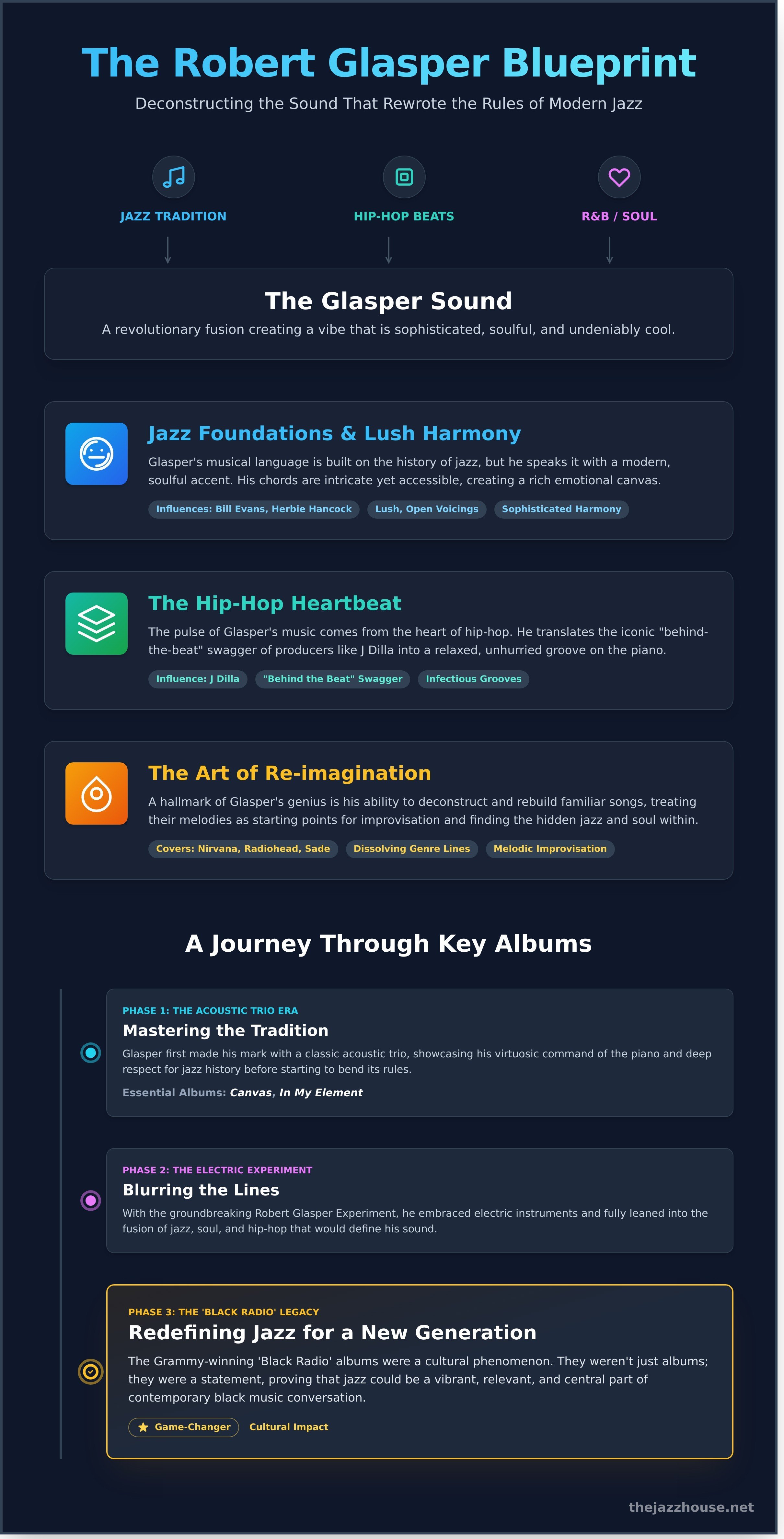
To listen to Robert Glasper is to hear a conversation between worlds. His signature sound isn't just a style; it's a statement-a sonic blueprint for modern cool. Imagine a master chef blending the rich, complex flavors of a five-star meal with the comforting, irresistible pull of your favorite soul food. That's the Glasper experience: sophisticated jazz harmony served with a groove so deep you can't help but move. He makes the complex feel effortless and the familiar sound brand new, inviting everyone to the table.
Jazz Foundations, Hip-Hop Heartbeat
At its core, Glasper’s language is fluent in jazz history. You can hear the introspective, sophisticated harmonies of Bill Evans and the funky, electric explorations of Herbie Hancock in his DNA. But the pulse-the very rhythm that drives his music-comes straight from the heart of hip-hop. As detailed in an insightful profile in JazzTimes, he internalizes the iconic drum patterns of producers like J Dilla, translating their signature "behind the beat" swagger into a relaxed, unhurried feel on the piano.
The Soulful Piano Voicings
Glasper’s chords feel like a warm embrace. Where traditional bebop piano can be angular and tense, his voicings are lush, open, and drenched in the soulful traditions of gospel and R&B. He chooses chords that resonate emotionally, creating a rich harmonic canvas that is both intricate and immediately accessible. His elegant touch on the keys is a form of self-expression, a statement of cool confidence much like a classic jazz piano elegance white t-shirt communicates a love for the art form without saying a word.
The Art of the Re-imagination
Perhaps nothing showcases Glasper’s genius more than his ability to re-imagine the familiar. He famously deconstructs and rebuilds songs from artists as diverse as Nirvana, Radiohead, and Sade, treating their melodies not as fixed structures but as starting points for improvisation. By stripping a rock anthem or a pop ballad down to its emotional core, he finds the jazz waiting within, proving that a great melody can groove in any context. It's a testament to his vision that he doesn't just cross genres-he dissolves them.
A Journey Through Key Albums: The Evolution of an Artist
To truly understand the vibe and influence of Robert Glasper, you have to listen to his journey. His discography is more than a collection of songs; it’s a living narrative of an artist boldly redefining the melody of modern jazz. For anyone new to his sound, this curated guide maps out the essential stops on his evolutionary path.
The Acoustic Trio Era: 'Canvas' and 'In My Element'
Glasper first made his mark by mastering the classic piano trio, but with a fresh, undeniable groove. Albums like Canvas (2005) and In My Element (2007) are masterclasses in acoustic jazz, yet the seeds of his future sound are already there. Listen closely, and you’ll hear the rhythmic DNA of J Dilla and A Tribe Called Quest woven into the syncopation. His harmonic language was already so unique that it has been the subject of deep academic analysis of his musical style. These records are the foundation-pure, virtuosic, and brimming with the promise of what was to come.
The Game-Changer: 'Double-Booked'
The pivotal moment arrived with Double-Booked (2009). This album was a brilliant manifesto, split right down the middle. The first half features his acoustic trio in top form, while the second half unleashes the Robert Glasper Experiment for the first time on record. This was him putting the world on notice that he contained multitudes. Featuring the electrifying vocoder and sax of Casey Benjamin and the deep-pocket bass of Derrick Hodge, the Experiment was born, creating a sonic bridge between the jazz club and the hip-hop stage.
The 'Black Radio' Revolution
If Double-Booked was the bridge, Black Radio (2012) was the stunning new world on the other side. This Grammy-winning album didn't just blur the lines between genres; it erased them completely. It was a seamless symphony of jazz improvisation, neo-soul elegance, and hip-hop swagger that became a cultural touchstone. The album’s power was amplified by a breathtaking roster of collaborators who shared Glasper's vision, including:
- Erykah Badu
- Lalah Hathaway
- Mos Def (Yasiin Bey)
- Ledisi
- Lupe Fiasco
Black Radio wasn't just an album; it was a movement. It cemented Glasper's status as a revolutionary force, proving that jazz could not only be relevant but could lead the conversation in contemporary music.
The Power of Collaboration: The Robert Glasper Experiment and Beyond
For Robert Glasper, music is never a solo flight; it's a conversation. Collaboration isn't just a feature of his work-it's the very engine of his creative process. This philosophy is perfectly embodied in the Robert Glasper Experiment, a project that is far more than a backing band. It’s a collective of innovators, a living, breathing entity where jazz, hip-hop, and soul collide to create a sound that is entirely new. By inviting a diverse symphony of artists into his world, Glasper doesn’t just make records; he builds bridges, introducing the intricate language of jazz to audiences who might have never felt its groove before.
Bridging Worlds with Hip-Hop Royalty
Glasper’s piano isn't just an instrument; it's a passport. His iconic contributions to Kendrick Lamar’s masterpiece, To Pimp a Butterfly, infused the album with a deep, improvisational soul. This natural fluency in the hip-hop dialect is also clear in his work with legends like Yasiin Bey (Mos Def) and Talib Kweli. He further solidified this connection by forming the supergroup August Greene with the conscious lyricist Common and drummer Karriem Riggins, creating a powerful, resonant vibe.
The Voices of Neo-Soul and R&B
When Glasper collaborates with vocalists, he creates more than just an accompaniment-he crafts a sonic landscape. His work with neo-soul and R&B titans is a testament to this gift.
- Erykah Badu: Providing a lush, harmonic foundation for her unique vocal textures.
- Jill Scott: Weaving intricate piano melodies that dance around her powerful, soulful delivery.
- H.E.R.: Creating a modern, sophisticated R&B soundscape that allows her voice to shine with emotional clarity.
His jazz harmonies elevate their performances, turning each song into a rich, collaborative masterpiece.
Supergroups and Special Projects
Glasper's collaborative spirit extends to ambitious supergroups and tribute projects that honor the past while boldly pushing forward. With R+R=NOW (Reflect+Respond=NOW), he joins forces with artists like Terrace Martin and Christian Scott aTunde Adjuah to create music that is both sonically adventurous and socially aware. His reverence for the masters is beautifully captured in his Miles Davis tribute project, Everything's Beautiful, where he reimagined classic recordings. This deep respect for the legends is a sentiment shared by fans who proudly wear a Miles Davis 'Kind of Blue' t-shirt, connecting past and present in a celebration of timeless cool.
The 'Black Radio' Legacy: Redefining Jazz for a New Generation
If an album could define a cultural moment, Black Radio was it. Released in 2012, this project wasn't just a collection of songs; it was a broadcast, tuning into a frequency that connected the rich history of jazz with the urgent, modern pulse of hip-hop and R&B. It became a phenomenon, creating a whole mood and a new, sophisticated way to signal your musical taste. For countless listeners, this was the album that made jazz feel accessible, immediate, and undeniably cool again.
Breaking Down Genre Walls for Good
With Black Radio, Robert Glasper didn't just cross genre lines-he erased them entirely. The album is a masterful symphony of styles, where intricate jazz piano dances with the soulful vocals of Erykah Badu and the smooth grooves of Lalah Hathaway. This authentic fusion became a definitive blueprint for a generation of artists, proving that genres are fluid and that true artistry lies in honest expression, not rigid classification. Its influence echoes today in the sound of contemporary R&B and jazz.
Grammy Recognition and Mainstream Impact
The album's win for Best R&B Album at the 2013 Grammy Awards was a seismic shift. A jazz-rooted artist taking home a major R&B award sent a powerful message to the industry: the old categories no longer applied. This mainstream validation opened the floodgates, introducing millions of new listeners to Glasper's innovative sound and proving that genre-defying music could achieve massive critical and commercial success.
Inspiring a New Wave of Artists
The ripple effect of Black Radio is undeniable, paving the way for a new vanguard of artists like Kamasi Washington, Terrace Martin, and Thundercat who continue to push jazz into exciting new territories. Glasper created a space where instrumentalists could be stars again, celebrated for their virtuosity and vision. His legacy is more than just music; it's a vibe you can wear, a cool confidence captured in the spirit of a distress grunge jazz t-shirt. He made musicianship the main event, and the world is still listening.
The Enduring Groove of a Modern Master
From his revolutionary work on the piano to the groundbreaking collaborations that defined the Black Radio era, Robert Glasper has fundamentally reshaped the rhythm of contemporary music. He didn't just play jazz; he deconstructed it, infusing its classic structures with the raw energy of hip-hop, the soul of R&B, and an undeniably cool vibe that invited a new generation to listen. The legacy of Robert Glasper is a testament to the power of artistic evolution, proving that the most timeless sounds are often born from breaking the rules and creating a space where all genres can coexist in perfect harmony.
Inspired by this spirit of bold self-expression? It’s time to let your own style sing. Find your groove and express your style with our collection of jazz-themed apparel. Our designs celebrate the icons of both modern and classic jazz, so you can wear your passion with pride. Each piece is crafted from premium quality materials for ultimate comfort and style, allowing you to make a statement without saying a word. Join a community of passionate music lovers and embrace the beat that moves you.
Frequently Asked Questions About Robert Glasper
What is Robert Glasper's most famous album?
Without a doubt, Glasper's most iconic and commercially successful album is "Black Radio" (2012). This masterpiece, which won the Grammy for Best R&B Album, is celebrated for its seamless fusion of jazz, hip-hop, and neo-soul. Featuring a stellar lineup of guest artists like Erykah Badu and Lalah Hathaway, the album redefined the contemporary jazz sound for a new generation, creating a vibe that is both sophisticated and deeply soulful.
Is Robert Glasper's music considered real jazz?
Absolutely. While his sound is a rich tapestry of hip-hop, R&B, and gospel, the core of his music is rooted in jazz improvisation and harmonic complexity. Purists may debate the label, but Robert Glasper embodies the genre's spirit of evolution. He uses jazz as a foundation to explore new rhythmic and melodic territories, proving that the art form is not a museum piece but a living, breathing groove that continues to grow.
Who are the core members of the Robert Glasper Experiment?
The Robert Glasper Experiment is built around a core quartet of masterful musicians. Besides Glasper on keys, the band features Casey Benjamin on saxophone and vocoder, Derrick Hodge on bass, and Chris "Daddy" Dave on drums. Their incredible chemistry allows them to move effortlessly between tight grooves and expansive improvisation. This lineup forms the rhythmic and melodic heart of the Experiment's groundbreaking sound, creating a powerful musical conversation on stage.
How many Grammy Awards has Robert Glasper won?
Robert Glasper is a celebrated musician who has earned significant recognition from the Recording Academy. As of early 2024, he has won five Grammy Awards from twelve nominations. His wins span across multiple categories, highlighting his versatility. Notable victories include Best R&B Album for "Black Radio" in 2013 and, a decade later, Best R&B Album for "Black Radio III" in 2023, cementing his legacy as a consistently innovative artist.
What hip-hop artists has Robert Glasper worked with?
Glasper's work is a masterclass in collaboration, creating a symphony of sound with hip-hop's finest. He has worked with a legendary list of artists, including Kendrick Lamar on "To Pimp a Butterfly," Common, Mos Def (Yasiin Bey), Mac Miller, and Q-Tip. His deep connection to the genre is also evident in his tribute album to the iconic producer J Dilla, titled "Everything's Beautiful," which re-imagined the music of Miles Davis.
Where can I find Robert Glasper's tour dates?
To catch the incredible vibe of a live performance, the best place to find official tour dates is on Robert Glasper's official website. You can also follow him on major ticketing platforms like Bandsintown, Songkick, and Ticketmaster for the latest announcements, concert details, and ticket information. These resources are regularly updated, ensuring you won’t miss the chance to see him perform when he’s in a city near you.


