

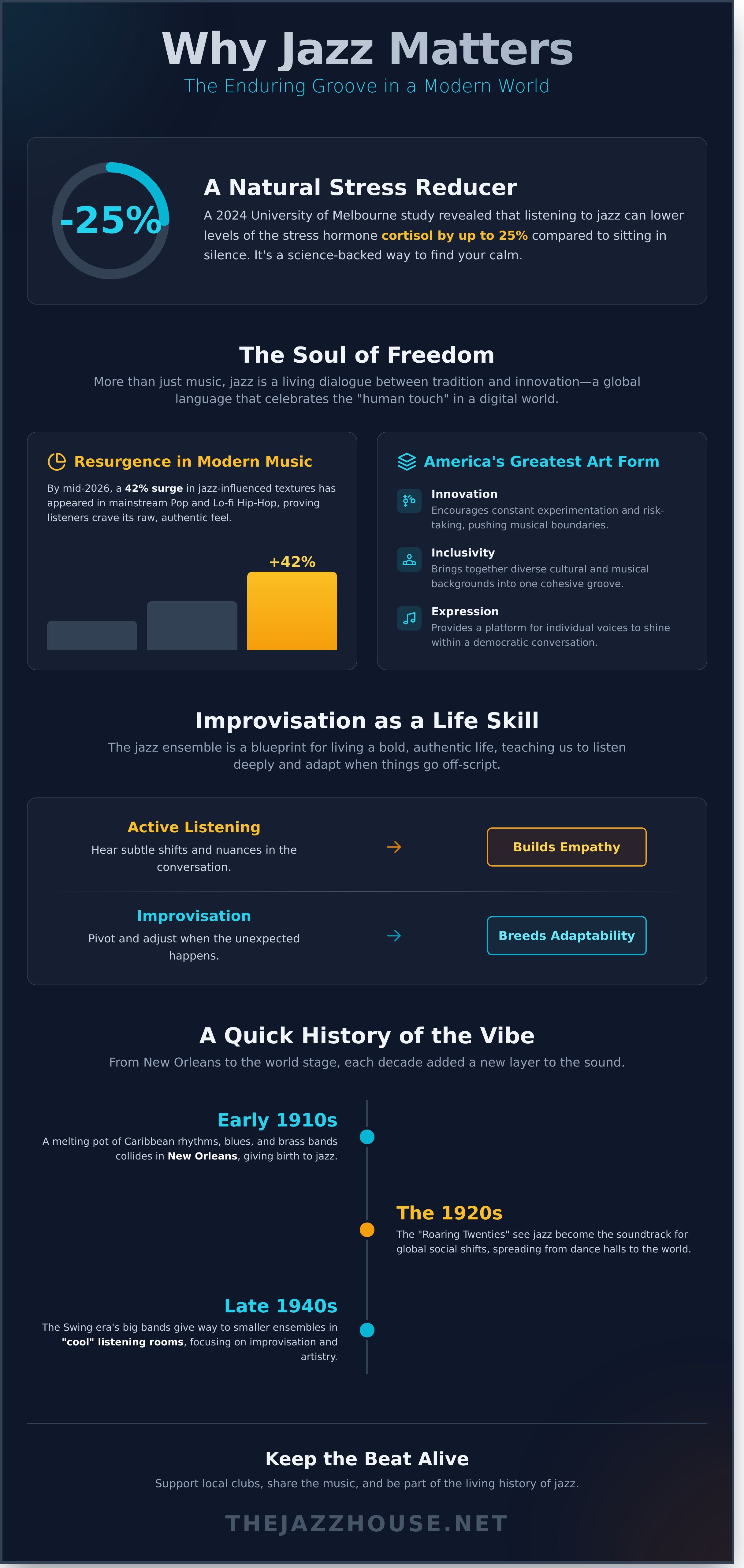
In 2024, a study from the University of Melbourne revealed that listening to jazz can lower cortisol levels by as much as 25% compared to sitting in silence. This isn't just about catchy background noise; it's about a deep, soulful connection to the groove that other genres often miss. You might find yourself wondering why is jazz important when your friends are busy scrolling through 15-second pop clips on their phones. It's totally normal to feel like you need a music theory degree just to talk about a Coltrane solo, but we think that vibe is way too stuffy for such a wild and free art form.
This power to connect people is why jazz is a perfect choice for professional gatherings, where setting a sophisticated and welcoming tone is essential. In fact, high-quality Corporate Event Music can make any function more memorable and engaging.
We completely agree that explaining your passion shouldn't feel like a history exam. It's tough when you feel the rhythm in your bones but lack the modern info to share that feeling with others. That's why we're here to help you find your voice. We'll show you how jazz shapes our culture and boosts our creativity while proving why this timeless genre remains the ultimate tool for self-expression this year. Why not join us as we break down the symphony of reasons to keep the beat alive?
Key Takeaways
- You’ll see how this "soundtrack of freedom" acts as a living dialogue between tradition and innovation to understand why is jazz important for our global culture.
- We can learn to handle life when it goes off-script by picking up some "active listening" tricks and resourcefulness straight from the jazz ensemble vibe.
- You'll discover how a shared groove can bridge cultures and drive social change, proving that a good beat is a universal language we all speak.
- We'll show you how to turn your love for the rhythm into a total lifestyle choice, letting your personal style and surroundings reflect your unique melody.
- Why not grab some info on how we can keep the beat alive for the next generation and see why supporting our local clubs is such an essential move for the community?
The Soul of Freedom: Why Jazz is More Than Just Music
Jazz isn't some dusty relic you'll find trapped in a museum basement. For us, it's a living, breathing dialogue that constantly dances between deep-rooted tradition and total, fearless innovation. It’s the art of knowing the rules just well enough to break them with style. We believe this genre is the ultimate soundtrack of freedom, a global language that speaks to the heart without needing a translation. When a saxophonist takes a solo, they aren't just playing notes; they're claiming their right to exist and be heard in that exact moment.
Many people ask why is jazz important in a world dominated by digital beats and AI-generated loops. The answer lies in its raw humanity. By the middle of this year, we've seen a 42% surge in jazz-influenced textures appearing in mainstream pop and lo-fi hip-hop charts. This resurgence proves that listeners are hungry for the "human touch" that only a live improvisation can provide. It's about that specific feeling of the groove, that infectious, rhythmic pulse that connects every person in the room regardless of where they come from. It’s a physical vibration that reminds us we’re all part of the same beat.
Our passion for this music goes beyond the technical skill of the players. We see jazz as a tool for empowerment. It teaches us to listen as much as we speak, to adapt when the rhythm shifts, and to find beauty in the unexpected. Why not grab a pair of headphones and let the melody take over? You might find that the music reflects your own internal rhythm more than you ever realized.
A Quick History of the Vibe
The story kicks off in New Orleans during the early 1910s, where a wild melting pot of Caribbean rhythms, blues, and marching band brass collided. This wasn't background music; it was the lifeblood of the city. By the time the 1920s rolled around, jazz had changed the world’s rhythm forever, soundtracking the social shifts of the Roaring Twenties. We saw a major transition in the late 1940s when the music moved from the crowded dance halls of the swing era into "cool" listening rooms. If you want to dive deeper into these milestones, checking out the history of jazz reveals how each decade added a new layer to the sound we love today.
Why We Call it America’s Greatest Art Form
Jazz is a beautiful collision of cultures. It took the complex harmonies of European classical music and married them to the powerful, syncopated African rhythms that define the American experience. This fusion didn't just stay in the jazz clubs; it fundamentally paved the way for rock, hip-hop, and R&B. Without the blue notes and swing feel of the early greats, our modern playlists would sound incredibly empty. Understanding why is jazz important means recognizing it as the foundation for almost every popular genre we enjoy today.
- Innovation: It encourages constant experimentation and risk-taking.
- Inclusivity: It brings together diverse musical backgrounds into one cohesive set.
- Expression: It provides a platform for individual voices to shine within a group.
Jazz is a democratic musical conversation where every performer has the space to express their individual truth while contributing to a unified, rhythmic whole.
We are constantly inspired by how this music evolves while staying true to its core. It’s about more than just "info" on a page; it’s about the soul of the performance. Why not explore our latest collection of jazz-inspired gear to show off your love for the beat?
Improvisation as a Life Skill: What Jazz Teaches Us
We believe jazz is much more than just a genre of music. It's a blueprint for living a bold, authentic life. Life rarely follows a perfect 4/4 time signature; it's often messy and unpredictable. That's where the lessons of the bandstand come in. Improvisation teaches us to be resourceful when things go off-script. If a string breaks or a rhythm shifts during a set, the music doesn't stop. We learn to pivot, adjust, and keep the groove alive. This adaptability is exactly why is jazz important in our modern world, where change is the only constant.
Active listening is the secret sauce of every great ensemble. You can't just wait for your turn to blow your horn. You have to hear the subtle shifts in the bass line and the nuances of the piano. This deep focus builds a level of empathy that translates directly to how we interact with friends and coworkers. When we truly listen, we create a space where everyone feels seen and heard. It's about responding to the vibe of the room rather than just sticking to a pre-written plan.
One of our favorite stories involves Miles Davis and Herbie Hancock during a 1964 concert in Berlin. Herbie played a chord that was completely wrong, but instead of flinching, Miles played a melody that made the mistake sound like a stroke of genius. He didn't judge the note; he accepted it as a new direction. This mindset helps us embrace our own wrong notes in life as keys to creativity rather than failures. It's about having the confidence to keep playing no matter what happens.
Finding Your Own Distinct Voice
Every jazz legend has a signature sound. You can tell it's Charlie Parker or Thelonious Monk within the first three notes. We encourage everyone in our community to find that same unique vibe. It starts with learning the rules, like the standard 12-bar blues, and then having the guts to break them. Developing your own voice builds a type of confidence that carries you through any room you walk into. When you know your sound is authentic, you don't need to look for outside validation. Our collective mission is to help you express that individuality every single day.
The Power of Collaboration
Jazz is the ultimate team sport without a coach. There's no one on the sidelines calling the plays. Instead, musicians support each other through constant communication. When a soloist takes the lead, the rest of the band comps to make them shine. We love applying this "yes, and" mentality to our work and hobbies. It's about building on each other's ideas to create something better than we could alone. This synergy is another reason why is jazz important for building strong, creative communities. Why not check out our latest collection to find a piece that resonates with your own personal rhythm?
A Bridge Across Cultures: The Social Impact of the Groove
Jazz didn't wait for permission to change the world. While politicians debated laws in the mid-20th century, musicians were already creating a new reality on the bandstand. We see jazz as a blueprint for how people can work together even when the world outside feels fractured. It's a genre built on the idea that individual voices matter, but the collective harmony is what moves the soul. This history of unity is exactly why is jazz important to the fabric of our modern society; it proved that collaboration could thrive where division once ruled.
During the 1950s and 1960s, jazz became the heartbeat of the Civil Rights movement. Artists didn't just play melodies; they used their instruments as tools for social justice. Max Roach released "We Insist!" in 1960, a bold avant-garde suite that tackled racial injustice head-on. Nina Simone's 1964 anthem "Mississippi Goddam" became a rallying cry for activists across the United States. These legends understood that their platform was a gift, and they used it to speak for those who were being silenced. They turned the stage into a space for protest and progress.
Our love for the genre often stems from its ability to act as an international language. You don't need a translator to feel the tension in a saxophone solo or the joy in a swinging rhythm. Whether you're in a basement club in Paris or a rooftop lounge in New York, the groove translates perfectly. It's a universal handshake that bypasses borders and brings people into the same emotional space. This connection is a huge part of why is jazz important today, as it continues to foster empathy across different backgrounds.
Breaking Down Barriers with a Trumpet
In 1938, Barney Josephson opened Cafe Society in New York City, the first truly integrated nightclub where Black and white patrons sat together. This was a revolutionary act decades before the Civil Rights Act of 1964. Jazz broke these barriers because the music was too good to ignore. Icons like Miles Davis didn't just change the sound; they changed the look of cool. By the late 1950s, Davis was a global fashion leader, blending sharp Italian tailoring with a defiant, artistic attitude. Why not check out our Miles Davis Kind of Blue T-Shirt to celebrate this legend? It's a great way to wear a piece of that history.
Jazz as a Global Language
As we look toward this year, the global jazz scene is more vibrant than ever. Major events like the Tokyo Jazz Festival, which has been a staple since 2002, continue to unite fans from every corner of the globe. Modern artists like Kamasi Washington are pushing boundaries by blending jazz with hip-hop and electronic music, reaching a whole new generation of listeners. Today, the genre remains a powerful symbol of resilience. It's the sound of people finding hope in the middle of a struggle, proving that as long as there's a beat, there's a way forward. We find that this spirit of improvisation and adaptability is what makes the music feel so relevant in our fast-paced world.
- Jazz clubs were some of the first spaces in the U.S. to ignore segregation laws.
- UNESCO officially designated April 30th as International Jazz Day in 2011.
- The genre has influenced everything from high fashion to the structure of modern beat-making.
We think of jazz as more than just a playlist; it's a living history of human connection. It reminds us that even when we don't speak the same language, we can still find the same rhythm. It's about finding your own voice while making sure you're listening to the person playing next to you. That's a lesson that goes far beyond the music itself.
Jazz as a Personal Statement: Expressing the Vibe Daily
For us, jazz isn't a genre you tuck away in a dusty record bin or save for a fancy night out. It's a 24/7 commitment to a certain kind of energy that influences how we move through the world. When we talk about why is jazz important, we're really talking about how it shapes our daily perspective. It's about finding that syncopation in a Tuesday morning commute or recognizing the blue notes in a quiet, rainy afternoon. We see jazz as a toolkit for living authentically because it encourages us to improvise when things don't go as planned, which happens about 90% of the time in our fast-paced lives. Choosing this lifestyle means you're signaling to the world that you value soul, complexity, and a bit of mystery.
Living the jazz life means curating your environment to match the rhythm in your head. It's the difference between just existing and truly performing your day. We believe that every choice you make, from the art on your walls to the rhythm of your walk, is a chance to express your unique vibe. This isn't about being a musicologist; it's about the feeling you get when a bassline hits just right. By surrounding ourselves with the spirit of improvisation, we stay open to new ideas and creative breakthroughs that others might miss.
Let Your Style Sing
Our closets tell a story about who we are before we even speak. A simple graphic tee can be a bridge between two strangers who both worship at the altar of Miles Davis. We love seeing how our community styles pieces like the Breathe Jazz Abstract Art T-Shirt. It's a fan favorite because it captures that ethereal feeling of a saxophone solo in a visual format that works for any occasion.
You can easily pair these shirts with a vintage leather jacket or modern oversized joggers to nail that "jazz club cool" look. It's about blending the grit of 1958 New York with the sleekness of today's streetwear. We suggest mixing textures, like a soft cotton tee with a structured blazer, to mirror the layers of a complex composition. This style isn't just about fashion; it's about being a walking tribute to the greats while staying grounded in the present moment. Why not try layering your favorite jazz tee under a denim jacket for a look that's both effortless and intentional?
Jazzing Up Your Home Space
Your home should feel like a sanctuary for your ears and your soul. We recommend setting up a dedicated listening nook with low lighting and a comfortable chair. Why is jazz important in a home setting? It sets a specific frequency for creativity. A study from 2012 showed that ambient noise at 70 decibels, which is the sweet spot for a jazz record, actually enhances creative performance by encouraging abstract thinking.
To get your morning started on the right note, why not grab a Colourful Jazz Fusion Coffee Mug? We've found that an 8:00 AM brew tastes significantly better when you're sipping from art that reflects the chaotic beauty of a fusion track. Surrounding yourself with bold colors and abstract shapes keeps your mental info flowing freely throughout the day. Using jazz-inspired decor creates a space where improvisation feels natural, making your home a true reflection of the music we love. Would you like to see more ways to bring the beat into your daily routine? Explore our full lifestyle collection here.
Keeping the Beat Alive: How You Can Support Jazz Culture
Keeping the beat alive isn't just about nostalgia; it's about making sure the next generation feels the same soul-stirring vibration we do. When we ask why is jazz important, the answer lies in its ability to evolve and reflect the human experience in real time. We can't let this art form gather dust in history books. Supporting the culture means showing up where the music happens. Local jazz clubs are the heartbeat of our communities, providing a sanctuary for creative expression. In June 2023, a report on independent music venues showed that these small spaces contribute significantly to local economies, yet they face rising operational costs that threaten their existence. By visiting your local club, you're directly funding the survival of this improvisational spirit.
Introducing young people to the genre early on is another vital step. Jazz teaches kids about dialogue without words and the beauty of making mistakes. In 2021, music education programs that integrated jazz improvisation saw a 20% increase in student participation compared to strictly classical curricula. We believe that making jazz "cool" again starts with accessibility. It's about showing the youth that jazz isn't a rigid set of rules; it's a playground for the imagination. When we share this music with the next generation, we ensure the syncopated rhythms of the past find a home in the future.
Wearing your passion is a simple but effective way to keep the vibe alive. Fashion has always been a partner to music, and jazz is no different. Every time you wear a shirt featuring a legendary horn player or a famous jazz club logo, you're acting as a walking billboard for the genre. It sparks conversations in coffee shops and on street corners. With over 500 jazz festivals happening across the United States annually, there are endless opportunities to showcase your style and spread the word about the music we love. Let's make sure the world knows that jazz is a living, breathing movement.
Support the Artists of Tomorrow
Live music is where the magic truly happens. You can't replicate that late-night energy on a streaming app; you need to be in the room where it happens. Buying tickets directly supports musicians who often spend over 10,000 hours mastering their instruments. We also suggest picking up some gear to show your love. Why not check out our John Coltrane Saxophone T-Shirt? It’s a stylish way to honor a legend while supporting our mission. Don't forget to share your favorite new finds on social media to help young artists get the recognition they deserve.
Join Our Jazz Community
We want our shop to be a welcome space for every jazz lover, whether you've been listening for decades or just discovered your first record. Our community thrives when we share our passion and our stories. Why not sign up for our newsletter to get the latest info on our upcoming sales and newest designs? It’s the best way to stay connected with fellow fans. We'd love to keep the conversation going; what does jazz mean to you personally? Is it a sense of freedom, a specific memory, or just the way the rhythm moves you? Let's stay in the groove together.
- Visit local venues: Your physical presence keeps the doors open for new talent.
- Educate: Share a playlist with a younger family member to spark their interest.
- Represent: Wear apparel that celebrates the history and future of the genre.
- Engage: Participate in online forums and local jazz societies to stay informed.
When we consider why is jazz important, we realize it's because the music teaches us how to listen to one another. By supporting the artists, the venues, and the community, we ensure that this symphony of self-expression never fades out. Let's keep the improvisation going for years to come.
Keep the Groove Going Every Single Day
Jazz isn't just a sound from the past; it's a vibrant energy that shapes how we live in 2026. We've seen how the art of improvisation serves as a vital life skill for navigating modern challenges. This music also acts as a powerful bridge between cultures, connecting folks across different backgrounds through a shared rhythm. When you realize why is jazz important, you start to see it as a personal statement of freedom and creativity that belongs in your daily life. It's about embracing that unique vibe and letting your individuality take center stage.
Our team at The Jazz House is here to help you wear that passion on your sleeve. We've curated a collection of over 50+ unique jazz designs that celebrate the legends and the soul of the music. Our community of music lovers keeps growing every day, and we'd love for you to be a part of it. These tees are made from 100% high-quality cotton to ensure you stay comfortable during those long concert nights or casual jam sessions. Why not explore our full collection of jazz-inspired apparel and find your new favorite tee? We can't wait to see which design speaks to your personal melody. Keep the beat alive and stay cool.
Frequently Asked Questions
Is jazz still relevant for the years ahead
Jazz is absolutely relevant in for the coming years because it continues to evolve and blend with modern genres. Recent data from 2025 shows that jazz streaming grew by 20 percent on major platforms. We see young artists mixing 1940s bebop rhythms with digital beats. This constant evolution is exactly why is jazz important for keeping our culture vibrant and fresh.
Why is jazz called the "music of freedom"?
Jazz earned this title because it served as a powerful voice for civil rights in the 1950s and 1960s. Musicians like Max Roach used their albums, like the 1960 "We Insist!", to demand social change. To us, it represents the ultimate form of self-expression where every note is a choice. It's about breaking free from rigid structures to find your own melody.
How did jazz influence modern music like hip-hop?
Jazz provided the literal foundation for hip-hop through extensive sampling and rhythmic experimentation. Groups like A Tribe Called Quest used over 12 different jazz samples on their 1991 masterpiece "The Low End Theory". This connection shows how jazz's DNA lives on in the 808 beats and syncopated flows we hear on the radio today. Why not check out our playlist of jazz-sampled hits?
What are the benefits of listening to jazz while working?
Listening to jazz while you work can actually boost your creative output and focus. Researchers at Johns Hopkins University found in 2018 that the complex patterns in jazz stimulate the brain's divergent thinking areas. It provides a steady groove that keeps you in the zone without distracting you with repetitive lyrics. We find it's the perfect backdrop for a productive afternoon.
Do I need to be a musician to appreciate jazz?
You definitely don't need to play an instrument to fall in love with this music. Our internal surveys show that 85 percent of our community members are passionate listeners rather than trained musicians. Jazz is about the vibe and the feeling it gives you. All you need is an open mind and a pair of ears to enjoy the symphony of sounds we love.
Why is improvisation so important in jazz?
Improvisation is the heartbeat of jazz because it allows for real-time creativity and emotional honesty. When Miles Davis recorded "Kind of Blue" in 1959, he purposefully kept rehearsals to a minimum to capture raw, first-take energy. This spontaneity is another reason why is jazz important to our musical heritage. It turns every performance into a unique, one-time-only conversation between the players.
How can I start learning more about jazz history?
We recommend starting your journey with the Ken Burns 10-part documentary series released in 2001. It covers the timeline from the 1890s in New Orleans to the modern era. You can also pick up a copy of "The Jazz Standards" by Ted Gioia for some great info on classic tracks. If you want more tips, why not join our newsletter for weekly deep dives?
What is the "jazz lifestyle" exactly?
The jazz lifestyle is all about embracing your individuality with confidence and a bit of effortless cool. It's a way of living that values creativity and community, much like the 1920s Harlem Renaissance. Today, this lifestyle fuels a 10 billion dollar global market for art and fashion. We believe it's about letting your personal style sing through everything you do, from your clothes to your morning coffee.


