

Does the word 'jazz' conjure images of complex, smoky clubs you're not sure you belong in? Or maybe just the bland background music in an elevator? It’s a common feeling, but the true spirit of jazz is far from intimidating. So, what is jazz music, really? At its core, it’s a conversation-a spontaneous, soulful dialogue between musicians telling a story without a script. It’s the sound of freedom, rebellion, and pure, unfiltered expression, born from a history as rich and complex as its melodies.
This guide is your backstage pass. We're here to demystify the sound, helping you find your groove in its syncopated rhythms and bluesy notes. We’ll explore its rebellious history, break down the essential elements like improvisation and swing, and introduce you to the legends who shaped its timeless cool. By the end, you'll not only understand jazz but feel its incredible soul, ready to start a listening journey that will last a lifetime. Let's embrace the beat.
Key Takeaways
- Discover that jazz isn't about rigid rules but a passionate musical conversation born from the soul of New Orleans.
- Trace the rebellious journey of jazz through the decades and meet the legendary icons who gave the music its unmistakable vibe.
- Get a clear answer to what is jazz music and find your personal groove with simple, non-intimidating ways to start listening today.
- Explore how the spirit of improvisation and self-expression in jazz sparked a cultural movement that went far beyond the music.
The Soul of Jazz: More Than Just Notes on a Page
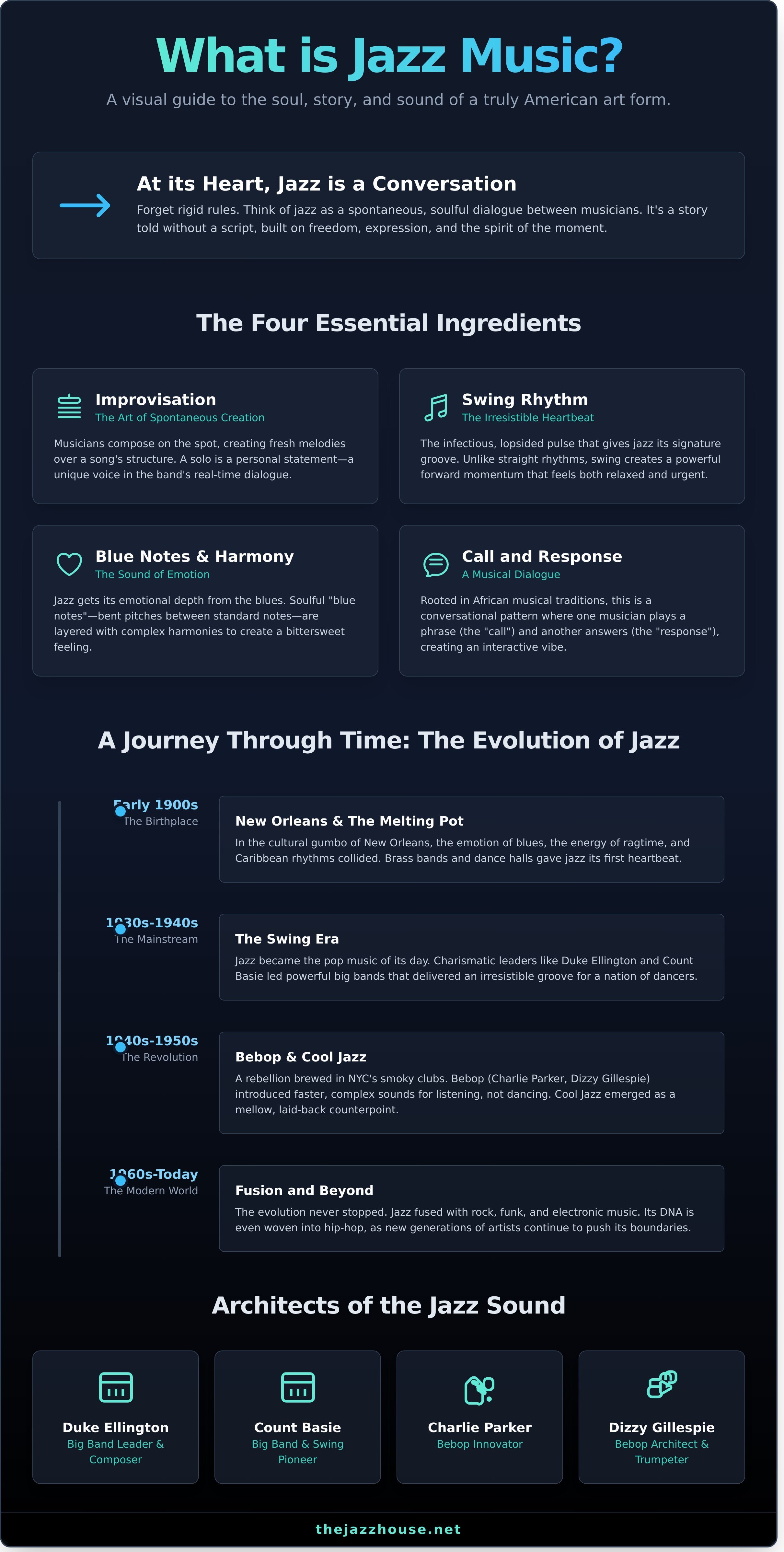
So, what is jazz music? Forget rigid definitions and dusty rulebooks. At its core, jazz is a living, breathing conversation-an art form built on freedom, expression, and the spirit of the moment. Born from the rich cultural experiences of African Americans in New Orleans, it’s a uniquely American sound that tells a story of resilience, joy, and profound creativity. While you can explore a comprehensive history of jazz to understand its full evolution, its soul is found in its spontaneous energy. It’s about taking a familiar song and making it entirely new and personal. This unique flavor comes from a blend of four essential ingredients.
Improvisation: The Art of Spontaneous Creation
At the heart of jazz is the electrifying art of improvisation. This is where musicians compose music on the spot, creating fresh melodies over a song’s structure. A solo isn't just a flashy display; it’s a deeply personal statement, a musician’s unique voice telling a story within the larger conversation of the band. Think of it as a spirited dialogue between instruments, where each player listens and responds in real-time.
Swing Rhythm: The Irresistible Heartbeat
Swing is the infectious pulse that gives jazz its signature groove-that irresistible rhythmic bounce that makes you want to move. Unlike the straight, even rhythm of most pop or rock music (ONE-and-TWO-and), swing has a lopsided, lilting feel (more like one-and-a-two-and-a). This unique rhythmic tension creates a powerful sense of forward momentum and an energy that feels both relaxed and urgent at the same time.
Blue Notes & Harmony: The Sound of Emotion
Jazz gets its deep emotional character from the language of the blues. It uses “blue notes”-soulful, bent pitches that live in the cracks between standard notes-to convey feelings from sorrow to elation. These are layered with complex, sophisticated harmonies that add incredible color and emotional depth. This combination is what gives jazz its characteristic bittersweet feeling, a sound that can be simultaneously joyful and melancholic.
Call and Response: A Musical Dialogue
A fundamental pattern in jazz, call and response is exactly what it sounds like: one musician or section plays a musical phrase (the “call”), and another answers with a complementary phrase (the “response”). This powerful conversational element has deep roots in African musical traditions and is a key part of the music's interactive, communal vibe. You can hear it everywhere, from a singer trading lines with the horn section to a drummer echoing a pianist’s riff.
A Journey Through Time: The Story and Evolution of Jazz
To truly understand what is jazz music, you have to follow its rhythm through history. It’s not a static genre frozen in time; it’s a living, breathing story of innovation, rebellion, and soul. From the vibrant streets of New Orleans to the global stage, the sound of jazz has constantly evolved, creating a rich tapestry of styles that mirrors the very pulse of the eras it defines. This journey shows that jazz is more than a sound-it’s a conversation across generations.
The Birthplace: New Orleans and the Melting Pot
It all began in the cultural gumbo of early 20th-century New Orleans. In this unique melting pot, the deep emotion of the blues, the syncopated energy of ragtime, and vibrant Caribbean rhythms all collided. Picture the scene: brass bands marching in street parades and infectious grooves filling the dance halls. This was where jazz found its first heartbeat, a raw and joyful sound born from community, expression, and celebration.
The Swing Era: Big Bands and the Age of Dance
By the 1930s and '40s, jazz had exploded into the mainstream, becoming the pop music of its day. The Swing Era was all about big sounds and bigger dance floors. Led by charismatic bandleaders like Duke Ellington and Count Basie, powerful big bands delivered an irresistible groove that became the soundtrack for a nation. This was music designed to move you, a symphony of style and energy that packed dance halls from New York to California.
Bebop & Cool Jazz: A Revolution of Sound
But the vibe was about to change. In the 1940s, a revolution brewed in the small, smoky clubs of New York City. Artists like Dizzy Gillespie and Charlie Parker pushed the boundaries with Bebop, a faster, more complex style built for intense listening, not dancing. This rebellious shift fundamentally altered the authoritative definition of jazz, elevating it from popular entertainment to a high art form. In response, Cool Jazz emerged, offering a smoother, more laid-back counterpoint with its mellow tones and understated elegance.
From Fusion to Today: Jazz in the Modern World
The evolution never stopped. Jazz continued to absorb new influences, fusing with rock, funk, and electronic music in the decades that followed. Its DNA is even woven into the fabric of hip-hop, with producers sampling classic jazz breaks to create new beats. Today, a new generation of artists continues to ask what is jazz music, pushing its boundaries and proving that this incredible art form is still improvising its future, one brilliant note at a time.
This global passion is especially evident in countries like Japan, which boasts a vibrant and dedicated jazz scene with world-renowned venues. For travelers looking to explore this or any other facet of the country's rich culture, you can visit Jasumo for helpful guides and resources.
Meet the Icons: Four Architects of the Jazz Sound
To truly understand jazz, you have to meet the personalities who gave it a soul. These figures were more than just musicians; they were architects of an entire cultural vibe, crafting a sound that was bold, brilliant, and unapologetically new. The question of what is jazz music is often best answered not with a definition, but by listening to the innovators who shaped its every rhythm and improvised phrase.
Louis Armstrong: The First Great Soloist
Before Louis "Satchmo" Armstrong, jazz was primarily a collective sound. He stepped into the spotlight and made the individual, improvised solo the heart of the performance. With his radiant trumpet playing and a gravelly voice as warm as sunshine, Armstrong’s music was pure, infectious joy. He became jazz's first global ambassador, his charismatic energy showing the world the profound power of self-expression.
Duke Ellington: The Sophisticated Composer
If Armstrong was the star soloist, Duke Ellington was the master painter who used the entire big band as his canvas. He was a genius composer and bandleader of unparalleled elegance, blending complex harmonies and unique instrumental voices to create a sound that was both sophisticated and deeply swinging. His work was pivotal in elevating the genre, and you can learn more about the history of jazz to grasp his full impact. Ellington proved that jazz belonged in concert halls as much as it did in dance clubs.
Miles Davis: The Eternal Innovator
Miles Davis is the embodiment of 'cool.' He never stood still, relentlessly pushing the boundaries of the genre and reinventing his sound for decades. From bebop to cool jazz, hard bop, and electric fusion, Miles was always at the forefront of the next wave. His minimalist, breathy trumpet style could convey more emotion in a single note than most could in a whole solo, making him a timeless icon of artistic restlessness and forward motion.
Ella Fitzgerald: The First Lady of Song
They called her the "First Lady of Song" for a reason. Ella Fitzgerald’s voice was an instrument of flawless technique and pure, unadulterated joy. She could swing with ferocious power or deliver a ballad that could break your heart. Her legendary scat singing-using her voice to improvise like a horn-was a masterclass in rhythm and melody. For anyone wondering what is jazz music in its vocal form, Ella remains the ultimate, definitive answer.
How to Start Listening: Your Guide to Finding Your Groove
Diving into jazz can feel like learning a new language, but here's the secret: you don't need a textbook. Forget the complex theory and the intimidating jargon. The first step is simply to listen with an open heart and let the rhythm guide you. It’s all about the feeling, the vibe, and what resonates with your soul. Embrace the journey and let your style sing along with the music.
Start with a Mood, Not a Subgenre
Don't get tangled in the web of 'bebop,' 'cool jazz,' or 'fusion' just yet. Instead, think about how you want to feel. Search for playlists like 'Late Night Jazz' for something smooth and reflective, or 'Coffee Shop Jazz' for an upbeat, creative vibe—a feeling that pairs perfectly with a quality brew from a brand like Café Delicioso. Starting with instrumental pieces lets you focus on the pure sound and the dynamic interplay between the musicians, giving you a direct line to the heart of the groove.
A 'Starter Pack' of Three Essential Albums
Ready for some foundational tracks? This curated trio is your perfect entry point into the vast world of jazz. Each album offers a unique flavor and has become a timeless touchstone for the genre.
- Miles Davis - Kind of Blue: The epitome of cool. This album is a masterclass in mood and understated brilliance, making it one of the most accessible and beloved jazz records of all time.
- Dave Brubeck Quartet - Time Out: You’ll instantly recognize the iconic rhythm of "Take Five." This album is playful, inventive, and a fantastic showcase of how jazz can experiment with time and structure in a way that’s pure fun.
- John Coltrane - A Love Supreme: For when you're ready to go deeper. This is a powerful, spiritual, and deeply moving suite that showcases the immense passion and technical genius of a true master.
Listen for the Conversation, Not Just the Melody
The real magic of jazz happens in the space between the notes. Instead of trying to follow everything at once, pick one instrument-the walking bassline, the shimmering cymbals, the soaring saxophone-and follow its journey through the song. Notice how the other musicians respond to a solo or a change in rhythm. This spontaneous interaction, this musical dialogue, is the heartbeat of the genre and a core part of the answer to what is jazz music. It's a live conversation captured on record, inviting you to listen in.
Beyond the Music: Jazz as a Culture of Self-Expression
Jazz has always been more than a genre; it's a full-blown cultural movement. To truly understand what is jazz music, you have to look beyond the notes and into the attitude it inspires. It is a philosophy built on improvisation, freedom, and bold self-expression. The rhythm of jazz doesn't just live in smoky clubs and on vinyl records-it pulses through art, fashion, and literature, shaping a unique identity defined by confidence and effortless cool.
This ethos of individuality is the bridge between simply listening to the music and actually living it. It’s about finding your own groove in a world that often demands conformity.
The Original Sound of Rebellion
From its very inception, jazz was a revolutionary force. Born from the African American experience, it gave voice to a community demanding freedom and respect. This was music that refused to be boxed in, breaking down racial and cultural barriers by bringing people together on the dance floor and in the concert hall. It has always been the soundtrack of progress, a defiant rhythm that challenges the status quo and celebrates the spirit of liberation.
The 'Cool' Aesthetic: How Jazz Shaped Style
The vibe of jazz is inseparable from its visual style. Think of the bebop era: the sharp suits, tilted berets, and dark sunglasses worn by icons like Thelonious Monk and Miles Davis. This wasn't just fashion; it was a physical manifestation of the music's sophistication and improvisational soul. The confidence required to play a solo was the same confidence worn in a perfectly tailored jacket. Jazz culture created a timeless blueprint for looking cool, calm, and completely in control.
Wear Your Vibe: Expressing Your Love for Jazz
Embracing jazz culture today means tapping into that same spirit of individuality. Your personal style is your own improvisation-a unique melody that tells the world who you are. Loving jazz is more than just listening; it's about living with creativity and confidence. It's about finding your own rhythm and not being afraid to play it loud. When you ask yourself "what is jazz music?", remember that the answer is also a feeling, an aesthetic, and a way of being.
Ready to make your own statement? Let your style sing. Explore our collection of jazz-inspired designs.
Find Your Rhythm in the World of Jazz
As you've discovered, jazz is so much more than notes on a page; it's a living conversation, a story of evolution, and a profound culture of self-expression. From the soulful blues origins to the improvisational genius of its icons, the answer to what is jazz music is ultimately found in the personal connection it sparks within you. This is a journey of discovery, and yours has only just begun.
Now, you can wear that passion and let your style sing. At The Jazz House, a brand built by passionate jazz lovers for jazz lovers, we translate the rhythm and soul of the genre into wearable art. Our collection features unique designs you won't find anywhere else, all crafted from premium, comfortable materials that feel as good as a classic vinyl sounds.
Find your groove. Discover a symphony of fashionable jazz t-shirts. Let the world know what moves you. Your stage is waiting.
Frequently Asked Questions
Do you need to understand music theory to enjoy jazz?
Absolutely not! Jazz is about feeling the groove and connecting with the emotion. It's an experience, not an exam. While theory can deepen appreciation for the technical skill, the real magic is in the raw expression and spontaneous conversation between musicians. Just let the rhythm move you and feel the vibe. It's a language of the soul, understood by listening, not by studying, so tune in and let it sing.
What is the difference between jazz and blues music?
Think of blues as the soulful parent and jazz as the adventurous child. Blues music typically follows a more structured chord progression, like the 12-bar blues, and focuses on raw, storytelling emotion. Jazz takes that emotional foundation and explores more complex harmonies, rhythms, and improvisation. While they share a deep, intertwined history and emotional core, jazz often features a more intricate musical conversation with a wider harmonic palette.
Is jazz just background music for restaurants and elevators?
That's a common misconception, but true jazz is anything but wallpaper. To truly understand what is jazz music, you have to experience it live. The "smooth jazz" you hear is just one quiet corner of a vast, dynamic universe. Real jazz is an electrifying art form full of bold improvisation and deep expression. It demands to be heard, not just overheard-a main event and a powerful statement you’ll want to join.
Why do jazz musicians play solos so much?
The solo is the heart of jazz self-expression! It's a musician's chance to step into the spotlight and share their unique voice, story, and personality. Think of it as a passionate, improvised monologue within the larger musical conversation. Each solo is a canvas for creativity, where the artist reinterprets the melody and harmony in a way that is entirely their own. It’s the ultimate showcase of individual style and in-the-moment invention.
Is jazz still popular today?
Absolutely! Jazz is alive and grooving. While it may not top mainstream pop charts, its influence is everywhere-in hip-hop samples, R&B melodies, and film scores. Artists like Kamasi Washington and Robert Glasper are pushing the genre in bold new directions, captivating new generations of listeners. From dedicated clubs to global festivals, the community celebrating this timeless art form is passionate, diverse, and constantly evolving. The beat goes on.
What are some of the most common instruments in a jazz band?
A classic jazz ensemble is built around a "rhythm section," which lays down the groove. This typically includes the double bass, drums, and a harmony instrument like the piano or guitar. Then you have the "front line" instruments that usually play the melody and take the solos. These are often brass and woodwind instruments like the saxophone, trumpet, or trombone. This combination creates the perfect symphony for improvisation and swing.


